

The Five Romes
Five people, five neighborhoods, five lives that may never cross. Because Rome isn't a city — it's an archipelago.
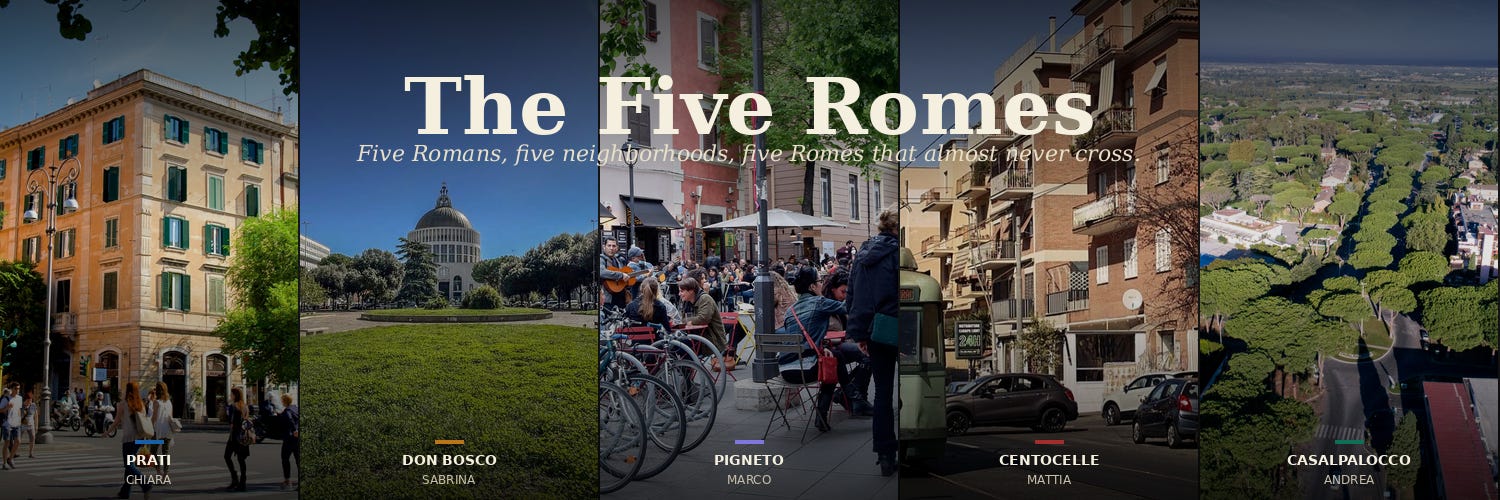
Rome covers 1,287 km². It’s larger than Milan, Turin, Bologna, Florence, and Naples combined. When a Milanese says “let’s meet after work,” they already have the bar in mind. When a Roman says the same thing, they first ask where you live and where you work, and somewhere between those two pieces of information they decide whether you’re actually meeting or whether it’s just a diplomatic promise.
This is the fact no guidebook tells you: Rome is too big to be inhabited “as a whole”. Every Roman lives a segment of the city — neighborhood, office, two or three emergency routes — and on that segment they build an idea of Rome that other Romans wouldn’t recognize. To understand how people actually live here, it’s not enough to look up “the neighborhoods you can’t miss”. You have to follow real people — to their door, to their desk, to the back seat of their motorino, to the warehouse on the Pontina.
I’ve taken five. Five real lives, reconstructed from profiles someone in Rome would recognize. Five neighborhoods chosen specifically to avoid the clichés: no Trastevere of the American expat, no Parioli of the rich kid. Rome is elsewhere — and it’s lived in five different ways that barely speak to each other.
1. Chiara, 41, civil lawyer — lives in Prati, works in Prati
Chiara lives on Via Pompeo Magno, second floor, an umbertino building from the late 1800s where the doorman has known her since she was three. The law firm is on Via Crescenzio. The Civil Court is at Piazzale Clodio. The Court of Cassation, when she needs it, is in Piazza Cavour. Between her bed and her most distant client there are twelve minutes on foot.
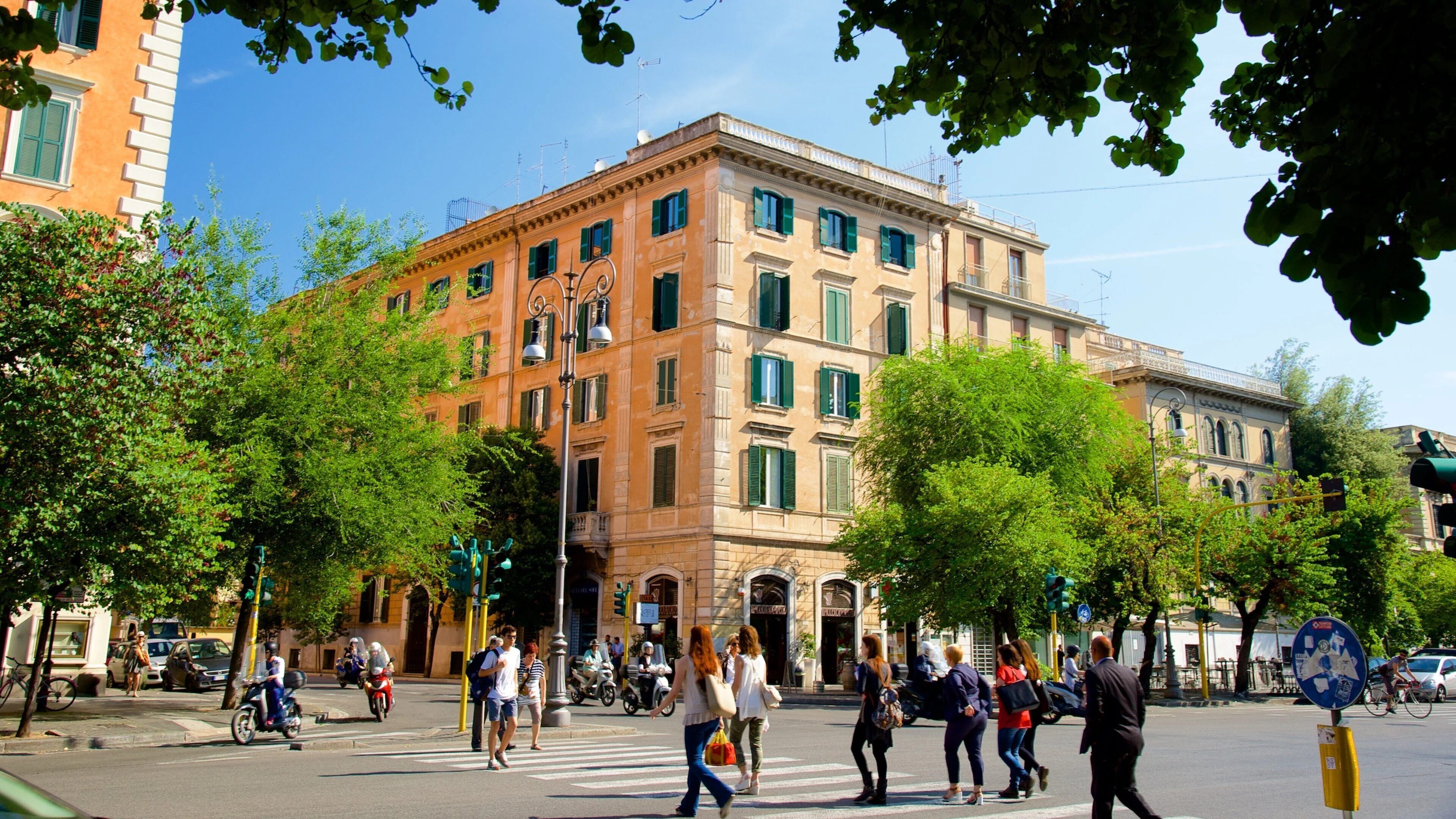
Chiara is the adult version of “compact” Rome: a city that exists only for the lucky few who live in Prati, on the Aventine, or in the few rectangles of the historic center where home and work share the same postal code. She almost never drives inside the city. She has an electric Smart in the building’s garage, which she uses on Saturdays for Fregene or, in August, for Sabaudia. Inside Rome, she only needs it for heavy grocery runs. In practice: never.
She rarely sits down for lunch. She goes to the counter at Franchi, on Via Cola di Rienzo, grabs a supplì and a tuna sandwich, and eats standing up with a colleague in ten minutes. When she has a serious client, she books at one of the historic trattorie of the neighborhood: close, old, discreet. The kind of place where the waiters don’t ask anything because they already know — a quarter litre of white wine, spaghetti alle vongole, seasonal fruit. For some — the most loyal regulars, not all — the rule of the old world still applies: you don’t pay at the table, you sign the check and settle at the end of the month.
Aperitivo, when she does it, is at 7:30 PM in one of the historic Prati cafés, or more simply at the counter of Sciascia Caffè on Via Fabio Massimo: the dark chocolate poured into the espresso cup, and someone telling her how the morning’s hearing went. Rome, for Chiara, isn’t an experience. It’s a habit. She lives it the way you live an apartment, not the way you visit a monument.
The historic center — the real one, the one tourists call “Rome” — is on the other side of Castel Sant’Angelo. Chiara crosses it only to go to the cinema (usually the Quattro Fontane) or when an out-of-town friend visits. Then she takes them to see “Rome”, with the slightly sad awareness of a Roman who knows that her daily Rome isn’t that one.
There’s one thing Chiara does that doesn’t fit the rest. Three evenings a week, at 7:30, she crosses the river and drives to a boxing gym in Testaccio — not the boutique kind, the old kind, in a basement under a former slaughterhouse, run by a former amateur middleweight from the Eighties. She wraps her hands, spars with women who work as nurses and cleaners and, in one case, a notary’s secretary. She has been doing this for nine years. None of her colleagues at the firm know. It’s the only time during the week when she leaves Prati without telling anyone where she’s going.
Her Rome: three rectangles — Prati, the historic center (rarely), Fregene (weekends). And one tunnel under the river, three nights a week.
2. Sabrina, 52, primary school teacher — lives in Don Bosco, teaches in Don Bosco
Sabrina is a second-generation Roman: her parents arrived from Frosinone in the seventies, she was born at the Policlinico, raised in the same building on Via dei Quintili where she now lives with her husband Antonio (a clerk at a small Italian bank near Piazza Re di Roma) and their two kids: Lorenzo, 22, engineering at Tor Vergata, and Giulia, 17, scientific high school in the Tuscolano district.
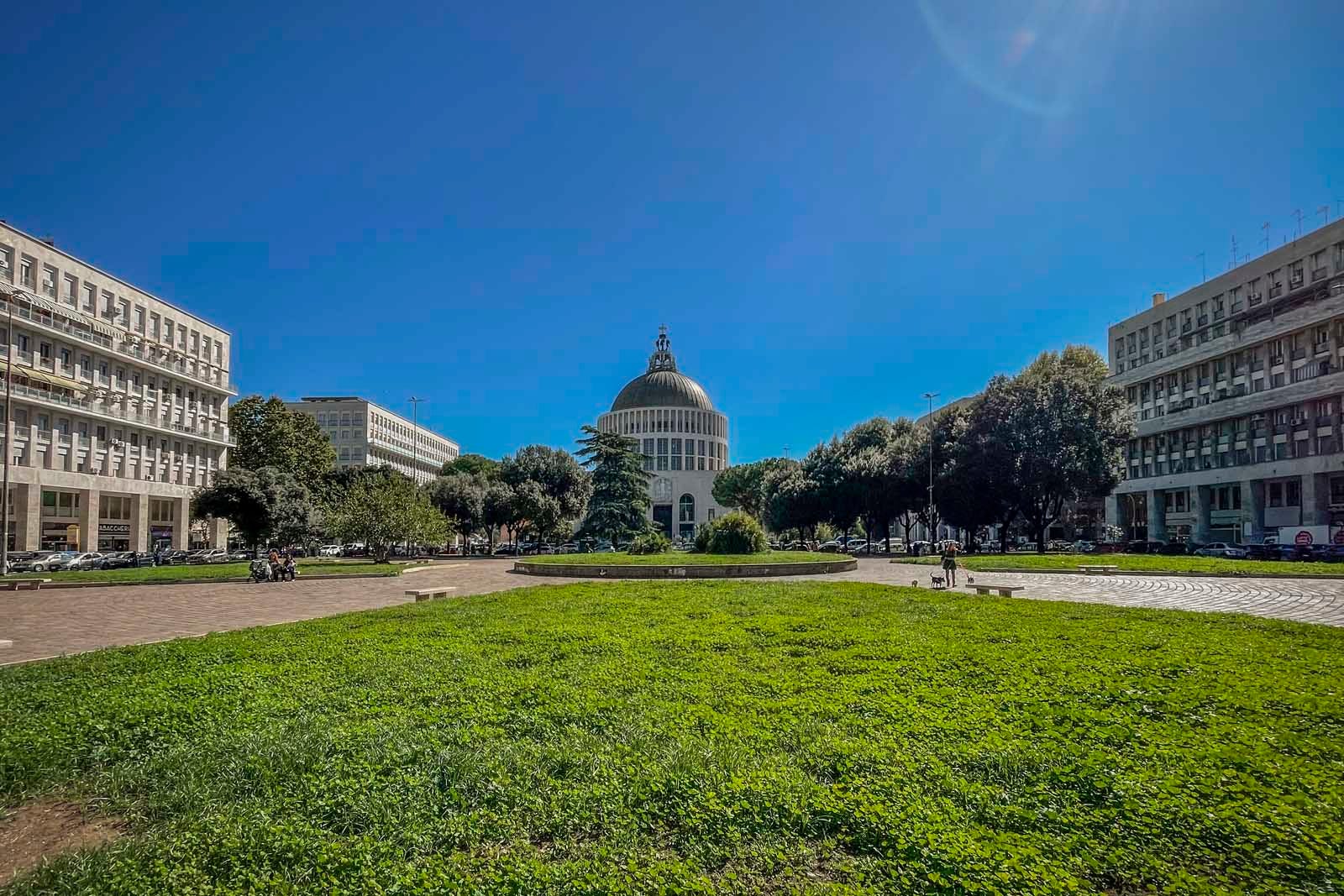
The primary school where she’s been teaching for eighteen years is twelve minutes on foot from her house. Sabrina has never taken the metro to work. Line A passes right under Via Tuscolana, but for her it would be absurd — going down the stairs, going up again, just to cover a distance that’s a pleasant walk. She owns a 2017 Fiat Panda that she uses for groceries at the neighborhood supermarket and to drive Giulia to dance class on Tuesdays. Antonio takes the 81 bus to Piazza Venezia. Sabrina doesn’t: her working life fits inside a one-kilometer circle.
For lunch, there’s the school canteen, which Italian primary teachers eat in by contract, alongside the kids — eight euros withheld from her paycheck per month, weekly rotating menus, a coffee in the staff room. When she finishes at 2:00 PM, she walks home, reheats whatever she cooked the night before, and by 3:30 she’s at the kitchen table with the red notebook, marking homework.
Aperitivo in the Milanese-Instagrammable sense doesn’t exist. What exists, instead, is the 11 AM coffee with the math teacher at the historic bar in Piazza Re di Roma, and the Thursday evening when the teachers meet at a birreria on Via Tuscolana for a beer and a chat — but not always, not every week. Sabrina’s real social ritual is Friday: family pizza at a Neapolitan pizzeria in the rione, or, if Antonio feels like driving ten minutes, a classic trattoria on Via Appia Nuova. Never more than thirty euros per person. Never booked the day before — you walk in and sit down.
Sabrina sees the historic center three times a year: at Christmas for the walk along Via del Corso with Giulia to see the lights, once for a concert at the Parco della Musica, and when she organizes the school field trip to the Roman Forum. For her, “Rome” is the neighborhood as a village: the local market, the Salesian parish, the florist on Piazza Tuscolo, the pharmacist who calls her by name, the dentist on Via Etruria. San Giovanni is her “capital”. Everything else is another city she once spent a few afternoons in, as a girl.
Her Rome: a circle of one and a half kilometers, fully inhabited, known person by person. A Rome that resembles a small Lazio town more than a metropolis.
3. Marco, 35, strategist at a creative agency in Monti — lives in Pigneto
Marco came to Rome from Salerno for university and never left. The agency where he works is on Via dei Serpenti, in Monti, in a building that probably housed a pensione in the seventies. He lives in a side street off Via dell’Acqua Bullicante, in Pigneto, third floor without an elevator, 850 euros a month split with a flatmate.
Between home and office there are nine kilometers on the map, but in Rome kilometers aren’t measured in kilometers — they’re measured in traffic lights. That’s why Marco owns an old black Vespa and lives a coherent life: the motorino is the only way to be Roman without surrendering to the geography. On a good day, he's on Via dei Serpenti in twenty-five minutes. On rainy days he takes Metro C from Malatesta, switches to A, gets off at the Colosseum, straight to Colosseo, and walks five minutes. Fifty About fifteen minutes door-to-door~~, but in the meantime he's listened to~~ — half a podcast.
Edit, 6 May 2026: the original version had Marco changing to Line A for a fifty-minute commute. Metro C has run directly to Colosseo since December 2025 — thanks to readers Eric J Lyman and Gillian for the correction. Marco’s life turns out to be considerably easier than I gave it credit for.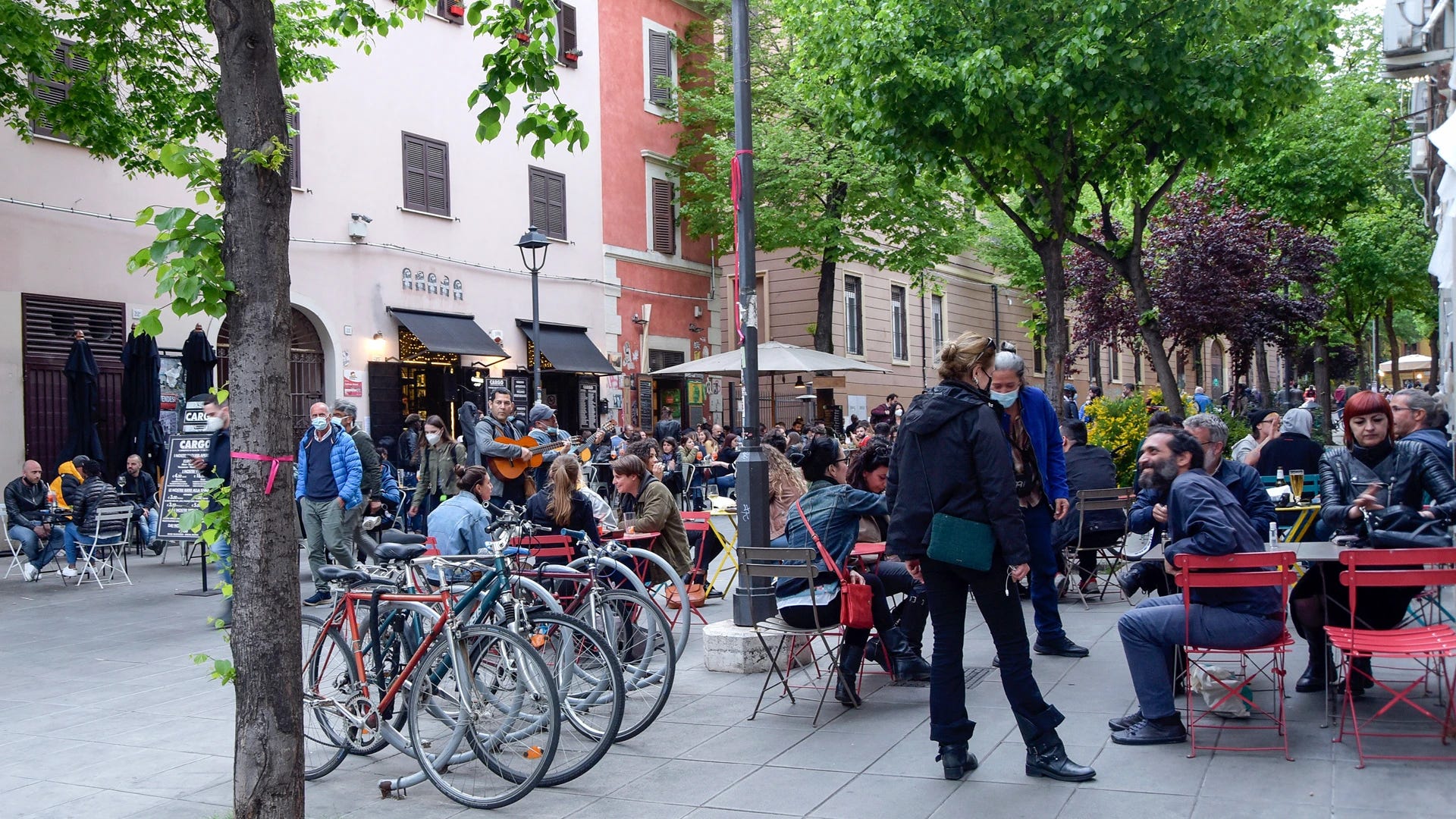
For lunch, during the week, he goes to one of Monti’s gourmet sandwich spots, or grabs a supplì and a slice of red pizza at the neighborhood bakery. When his calendar allows it — almost never — he makes the “Sunday journey” all the way to Mercato di Testaccio, to Mordi e Vai, for Sergio Esposito’s beef stew sandwich. It’s twenty minutes by motorino, but for Romans like Marco it’s a small identity pilgrimage.
Aperitivo is where Marco plays out his sense of belonging. He almost never does it in Monti, because Monti, he says, “has become Disneyland for foreigners”: cocktail bars too curated, Milan-level prices, people composing the photo before they drink. He goes back to Pigneto, to one of the historic cocktail bars of the neighborhood — fake leather sofas, pink lampshades, the woman at the bar who calls him “ammó“. When he wants to feel grown up, he goes to Drink Kong, near the Colosseum: the most awarded bar in Rome, the only place in the city where cocktails are crafted the way they are in Tokyo. When he just wants to drink, in Pigneto’s piazza, under the railway footbridge, there’s always an open table and a beer for five euros.
Marco lives Rome diagonally: Pigneto–Termini–historic center. It’s the route of the thirty-somethings who work in creative jobs and got pushed east because the center spat them out via short-term rentals. He knows the bars of Monti the way he knows the shortcuts of Pigneto, and in between is a city he sees from the saddle of the Vespa — never on foot, never through a car window.
His Rome: a straight line on the southeast/northwest axis, from home to Monti, with two or three points of emotional attachment (the historic bar in Pigneto, the record store on Via del Pigneto, a specific railing from which he watches the sun set over the Casilina tracks).
4. Mattia, 28, air conditioning technician — lives in Centocelle
Mattia was born and raised in Centocelle. His parents are from Rome — his father a retired ATAC bus driver, his mother a clerk at the post office on Via dei Castani. He still lives with them, in the same fourth-floor apartment off Viale dei Romanisti where he grew up, not by romantic choice but because on a technician’s salary in Rome you can’t put aside the three hundred euros for a shared studio. About 60% of his colleagues under thirty live with their parents. It’s called the labor market.
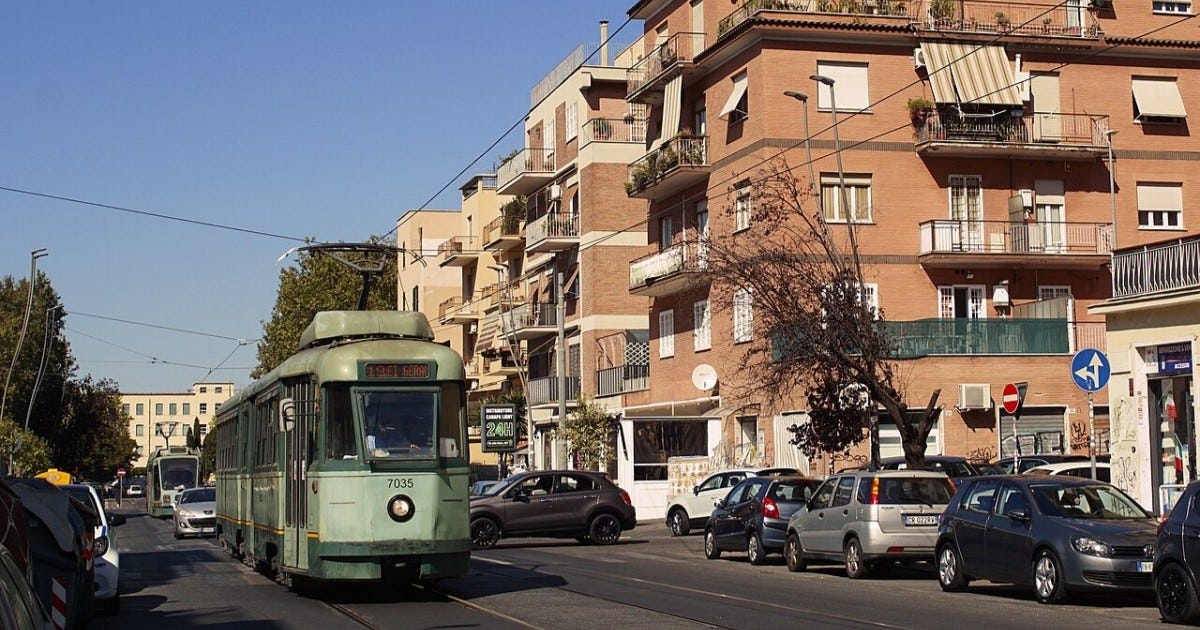
He works for a small company based in Tor Pignattara — five technicians, one secretary, a warehouse the size of a garage — that installs and services air conditioning units for apartments and small offices. He has the trade school qualification and a four-year on-the-job apprenticeship behind him. Speaks with a soft Roman cadence, never strong, never showy. The company has a fleet of three white Fiat Doblòs branded with the company logo on the side. Mattia’s is the oldest of the three.
His working geography is unlike anyone else in this piece. He doesn’t have a single route — he has a different one every day. The secretary sends him a list of addresses on WhatsApp the night before, and the next morning he picks them up in whatever order makes sense based on traffic. Monday: Talenti, Casal Bertone, Casalbertone again, Tor Vergata. Tuesday: a long job at a doctor’s studio in Parioli, then two condominiums in Spinaceto. Wednesday: a single intervention at a notary’s office in the historic center, on Via dei Banchi Vecchi. Thursday: Cinecittà Est, Romanina, Pietralata. Friday: whatever’s left. In a typical week he passes through eight or nine of Rome’s neighborhoods, but he passes through them the way water passes through a sieve — entering courtyards, intercom names, stairwells, ringing the buzzer, coming up with the toolbox, and leaving two or three hours later.
It is, in a way, the most complete Rome of any of the five. He has been inside the apartments of doctors and pensioners, lawyers and shop owners, families with three children and elderly women who live alone with twelve plants. He’s seen the kitchens of Parioli and the kitchens of Spinaceto in the same week. He knows that the doormen in Prati offer you a coffee before you start working, and that in some buildings of Talenti they don’t even let you use the lift. He could tell you which neighborhoods have buildings without elevators (most of Centocelle, half of Tor Pignattara) and which have buildings with two (Eur, Vigna Clara). He has a library of doors in his head.
But — and this is the catch — none of those neighborhoods is his. He passes through. He doesn’t inhabit. The condominium in Parioli where he installed a split unit last March exists for him as the third floor of a beige building with a fig tree in the courtyard, not as Parioli. When the secretary calls him to send him to a new address, he checks Maps and goes. He knows Rome the way a courier knows it: as a list of destinations.
Around 11:30, between the second and the third call of the morning, Mattia parks the Doblò along a street he doesn’t know, near the Casilina. The window is half down. The radio is on a station playing late-Eighties Italian pop. There’s a sandwich wrapped in foil on the dashboard. Through the windshield, two women are talking outside a haberdashery; one of them holds a small dog under her arm. He eats the sandwich without taking it out of the foil completely, watching them. Then the phone rings — the secretary, a new address on the Tiburtina — and he turns the engine on.
Lunch, when he can sit down, is whatever’s nearby — a slice of pizza al taglio, a sandwich at a tavola calda, sometimes nothing. Around 6 PM, if the day allows it, he’s back at the depot in Tor Pignattara, drops off the keys, picks up his own scooter — a beat-up Honda SH — and rides home to Centocelle. Dinner with his parents. On Thursday evenings, five-a-side football on a synthetic pitch off Via dei Castani: same teammates for ten years, one euro a head for the showers, beers afterwards at the bar of the sports field. That’s it. There’s no aperitivo. There’s no Saturday cocktail. There’s just the slow, accumulated tiredness of a year and a half spent doing other people’s air conditioning.
Mattia knows the historic center the way he knows everywhere else: as a stairwell. He installed a unit in a notary’s office on Via dei Banchi Vecchi last June, and the day before that he was in Tor Vergata. He couldn’t tell you which one was the better address. To him they were the same kind of address: one with a parking problem.
His Rome: a fragmented map. Not a corridor, not a closed ecosystem, not a trajectory — a constellation of forty or fifty courtyards seen from the inside, plus one neighborhood (Centocelle) where he sleeps. The Rome of the people who hold the city’s pipes and wires together, and who, of all five Romes here, see the most of it without inhabiting any of it..
5. Andrea, 48, executive at an energy multinational in EUR — lives in Casalpalocco
Andrea is the person Milan doesn’t know exists. He’s corporate Rome, ministerial Rome, managerial Rome: the Rome that at 7:30 AM takes the Cristoforo Colombo highway heading sea-EUR and locks itself for nine hours inside a glass tower between Via Laurentina and Viale Asia. Eni, Leonardo, ENAV, GSE, Acea, Banca d’Italia. Rome’s private-sector ruling class lives here, in buildings designed in the sixties or built after 2000 with glass facades that reflect nothing.
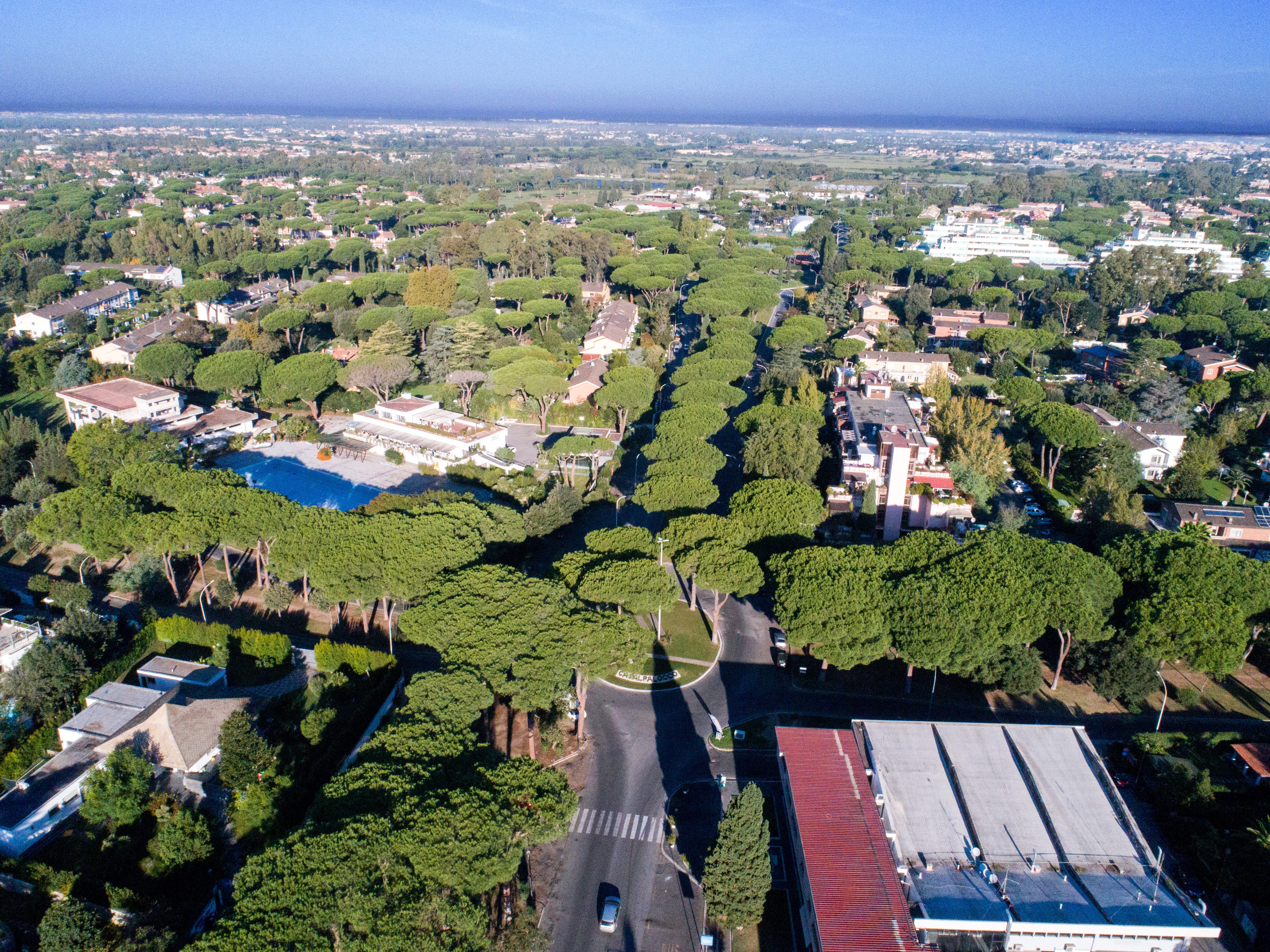
Andrea lives in the Axa, inside the Casalpalocco compound: townhouse, communal pool, two covered parking spots. He has four children and a wife who works at a private equity fund downtown (she takes the regional train from Torrimezza station; he doesn’t, never). The car is a BMW SUV. He’s never owned a motorino and never will. He last took the metro in 2018, for his kids’ jubilee school trip.
Lunch is at the company canteen, which in large Roman corporates is its own universe: first and second choice mains, daily pastas, the senior managers’ table in the right corner, the engineers’ table in the middle. When he has clients, he takes them to L’Archeologia on the Appia Antica (dinner, never lunch), or to the Rome Cavalieri restaurant on Monte Mario. Never downtown. “Too messy, too few parking spots, too much wasted time.”
After-work aperitivo, simply, doesn’t exist. Andrea is home by 7:30 PM, dinner with the kids at 8:30. The real aperitivo is Saturday afternoon in Fregene, at one of the historic beach clubs along the coast: Aperol Spritz, kids on the sand or the lawn, friends from the same neighborhood. In winter, dinner at Mirabelle, the rooftop restaurant of the Hotel Splendide Royal, or at the Casalpalocco Country Club restaurant, where the tables have known each other for thirty years and no one needs to introduce themselves.
Andrea lives a Rome that never meets the other four. For him, “the center” is a place he visits at Christmas to see the tree at Piazza Venezia with the kids, or four times a year for a business dinner at Pierluigi or Pipero. For the rest, Rome is Cristoforo Colombo, EUR, Casalpalocco, Fregene. A parallel Rome, coastal, suburban, vaguely American. It’s no accident that many Romans like him say “we’re going to Rome” when they go downtown. For them it’s not a figure of speech: they’re talking about another city.
Except. One Wednesday a month, Andrea drives into the historic center alone. He parks near the Senate, walks five minutes, and goes to the Cinema Trevi in Vicolo del Puttarello — the small theater of the National Film Archive, where they show retrospectives of restored Italian cinema, mostly to a crowd of old cinephiles and film students. Andrea has been a member for twenty-one years, since before he had children. He has a folder, at home, of the program leaflets he’s kept from every screening since 2003. His wife knows. His colleagues do not. He gets back to Casalpalocco around midnight, parks the BMW in the covered spot, and goes to bed.
His Rome: a southwestern trapezoid (Casalpalocco–EUR–Fregene–occasional incursion downtown). Rome, for Andrea, is a film set he’s never visited, not a place he inhabits. With one black-and-white exception, once a month, in a basement near the Senate.
Five Romes that almost never meet
Chiara, Sabrina, Marco, Daniele, and Andrea live in the same city across five separate dimensions. The two most similar geographies — Daniele’s and Andrea’s — belong to opposite social classes. The two most similar classes — Chiara and Andrea, upper-middle-class professionals — live opposite Romes. It isn’t class alone that decides which Rome you inhabit — it’s geography. And in Rome, by now, geography and class are the same conversation.
Each one inhabits a shape. Chiara’s Rome is a bourgeois room: small, tidy, walked. Sabrina’s is a village inside the metropolis — a circle of a kilometer and a half, known person by person, in a different postal code but with the same logic of proximity. Marco’s is a trajectory, a diagonal bundle of lines crossing the urban fabric from the saddle of a Vespa. Daniele’s is a working-class corridor, drawn by an old Fiat Punto between his neighborhood, the Pontina, and the Olimpico. Andrea’s is a closed ecosystem — Casalpalocco, EUR, Fregene — that needs nothing from the historic center.
These five shapes meet at very few points, and almost never by choice:
A Roma or Lazio match: there’s only one stadium and it acts as a great demographic equalizer. Through the same gates can pass Chiara (in the institutional box with a client), Marco (Distinti Sud Est), Daniele (Curva Sud), Andrea (Tribuna Tevere VIP).
The Christmas walk down Via del Corso, the once-a-year ritual when everyone — from Casalpalocco, from Trullo, from Don Bosco — drives or takes the metro into the center to see the lights and the tree in Piazza Venezia.
A concert at the Circo Massimo — Cesare Cremonini, an 883 reunion show — the kind of pop night when the whole city converges onto the same lawn, regardless of postal code or income bracket.
The visit of a friend from out of town who wants to see the center. That’s when Romans become tourists in their own city for an afternoon, eating a gelato at Giolitti or sipping a Negroni at Bar del Fico — places they otherwise wouldn’t set foot in for years.
An emergency (the 2018 snowstorm, a bus catching fire, an earthquake ninety kilometers away).
And then, sometimes, the geography slips. Two years ago Marco’s agency won the rebranding contract for Andrea’s company. They met three times — two meetings in a glass-walled boardroom at the EUR, one closing dinner at a restaurant Andrea chose. Andrea found Marco bright but young; Marco found Andrea less wooden than expected. They exchange a holiday message once a year. They are not friends. They will not see each other again.
This kind of encounter doesn’t refute the five Romes. It confirms them in a more sophisticated way. Because when Marco and Andrea were in the same room, neither of them was really in his own Rome. They were both in a sixth Rome — the working Rome of expense reports and Powerpoint, of conference rooms with bottles of mineral water on the table — that exists only on weekdays from 9 to 6 and disappears the moment they walk out of the building.
So the next time someone tells you “Rome is gorgeous” or “Rome is unlivable”, the question to ask is one: where do they start the morning, and where do they end the evening?
That’s their Rome. The others, simply, they’ve never met.
We are committed to keeping this magazine free and accessible to everyone, and your support is fundamental to making that possible. Don’t forget to hit subscribe if you enjoy content that reveals the real Italy, far beyond the clichés.


Thanks all for reading — and for the corrections!
Confession: I don't actually live in Rome. I visit often, but I get around on my brother's motorcycle and avoid ATAC like the plague — so I'd long since filed Metro C under "never-ending project" and stopped checking. Genuinely hadn't noticed it now reaches Colosseo. Marco from Pigneto is a luckier man than I gave him credit for, and I'll update the piece (Piazza del Popolo tree included).
To the San Paolo neighbor: loved your list. For what it's worth, my characters are all drawn from real people I've crossed paths with — but clearly my Rome is narrower than yours. Grazie!
This was a fun read. I feel like a sort of know a couple of these people.
I'm not the American in Trastevere, but the rare American in Quartiere San Paolo. I still don't fit into any of the categories, but I wonder where my Roman neighbors would fit: a cop, a medico di base, a swim coach, a university researcher, an art historian, a gelato maker, a lawyer, a retired ATAC driver. I really love the diversity of the neighborhood.
P.S. Your geography is a little out of date. As Gillian mentioned, Marco is lucky in that the Metro C now runs to the Colosseo. And the Christmas tree hasn't been at Piazza Venezia since 2022. After that, the continued work on Metro C made it impossible. These days it's in Piazza del Popolo, on the opposite end of via del Corso.